Transform Your Listing Presentation Like Steve Jobs
Real Estate, Listing Presentation, Steve Jobs Style
Your Listing Presentation Needs a Steve Jobs Rewrite: 3 Changes That Win More Listings
In the luxury market, a Listing Presentation isn’t a slideshow — it’s a high-stakes performance. If you want to consistently win premium listings, it’s time to stop thinking like a salesperson and start thinking like Steve Jobs unveiling the next iPhone: problem-first, story-driven, obsessively rehearsed, and unforgettable.
Why Your Current Listing Presentation Isn’t Winning Like It Should
Luxury sellers are not impressed by clip art CMAs, templated talking points, or twenty-page binders that feel like homework. They live in a world of curated experiences — private jets, bespoke travel, concierge banking. When they invite you into their home, they expect the same level of refinement from your Listing Presentation. They want clarity, confidence, and a sense that you are the only agent who truly understands what is at stake for them personally.
This is where a Steve Jobs Style approach changes everything. Jobs did not simply show features; he told a story about a problem, revealed a simple, elegant solution, and made his audience feel like they were stepping into the future. Your Listing Presentation can do the same — if you reimagine it around three powerful changes: opening with the seller’s problem, rebuilding on three memorable pillars with human language, and rehearsing like a keynote.
Change #1: Open with the Seller’s Problem, Not Your Resume
Most agents begin their Listing Presentation with themselves: awards, production numbers, company stats, glossy marketing pieces. In the luxury space, this is background noise. The seller already assumes you are competent; otherwise, you would not be sitting in their living room. What they do not yet know is whether you understand the specific, high-stakes problem they are trying to solve by selling this property, at this moment, in this market.
Steve Jobs always began with a problem: slow phones, confusing music players, fragmented devices. He made the audience feel the friction before he ever unveiled the solution. Your Listing Presentation should mirror that rhythm. The opening should be less “let me tell you about me” and more “let’s talk about what’s keeping you up at night about this sale.”
📌 Key Takeaway: In a luxury Listing Presentation, the seller’s problem is the true protagonist — not your production stats.
Turn Their Concerns into Your Opening Story
Before you ever open your laptop, you should already know the emotional and financial pressures surrounding this listing. Are they relocating on a strict timeline? Are they quietly divorcing and protecting privacy? Are they upgrading, downsizing, or liquidating an investment portfolio? This is where communication becomes your luxury advantage. Your pre-listing conversations, your questions, and your listening skills are the raw material for a powerful opening.
Instead of launching into market stats, you might open with something like: “From our conversations, I know you’re balancing two priorities: securing the right price to protect the capital you’ve built here, and doing it without your life feeling like an open house every weekend. Tonight, I’m going to show you exactly how we solve both of those problems.” In one elegant sentence, you have reframed the Listing Presentation as a tailored solution to their specific situation, not a generic pitch.
Storytelling That Centers the Seller
This is where the importance of storytelling comes into sharp focus. A Steve Jobs Style Listing Presentation does not simply list features of your service; it tells a story of transformation. The seller starts in one place — anxious, uncertain, overwhelmed — and ends in another, having achieved clarity, control, and a successful sale. When you open with their problem, you also open the door to a narrative arc where they can clearly see themselves as the hero of the story, with you as the expert guide.
Every example you share from this point forward should echo their situation: other clients with similar timelines, similar price points, similar privacy concerns. This is luxury communication at its finest — curated, relevant, and emotionally intelligent. You are not just talking about real estate; you are narrating a journey that feels bespoke to them.
Change #2: Rebuild on Three Memorable Pillars — in Human Language
Steve Jobs was a master of simplicity. No matter how complex the product, he distilled everything into a few clear, memorable pillars. Your Listing Presentation should do the same. Instead of a scattered tour through every possible service you offer, rebuild your presentation around three powerful pillars that directly address the seller’s problem — described in human, elegant language they can repeat later to their spouse, business partner, or attorney.
Crafting Your Three Pillars Around the Seller’s World
Think of your three pillars as the luxury framework of your Listing Presentation. They might look like:
Pricing with Precision: Not just a CMA, but a data-driven, narrative-backed pricing strategy tailored to their property’s unique position in the market.
Showcasing with Intention: A curated plan for presentation, staging, photography, and digital storytelling that amplifies perceived value and protects privacy.
Negotiating with Discipline: A clear, disciplined approach to offers, timing, and terms that safeguards their financial and emotional goals.
Notice that each pillar is expressed in language a seller can instantly grasp. There is no jargon, no internal office terminology. This is where the importance of communication is non-negotiable. Sophisticated clients appreciate nuance, but they also value clarity. Your job is to make a complex process feel elegantly simple — not simplistic, but streamlined, like a well-designed luxury product.
Use Storytelling to Bring Each Pillar to Life
A pillar without a story is just a heading. To make your three pillars unforgettable, pair each one with a concise, high-impact story. For example, under Pricing with Precision, share a brief narrative of a recent listing where your pricing strategy prevented the property from languishing on the market and instead created a quiet, competitive atmosphere that protected the seller’s privacy and price point. Under Showcasing with Intention, tell the story of how re-sequencing the photography and rewriting the property description shifted buyer perception and shortened days on market.
These stories do more than entertain. They demonstrate that you have navigated complex scenarios before, that you understand the subtle pressures of high-net-worth clients, and that your approach is both strategic and human. This is the heart of a Steve Jobs Style Listing Presentation: technology-level strategy delivered through warm, human storytelling.
Human Language as a Luxury Experience
In luxury, language is part of the experience. The way you describe your process should feel as considered as the way a luxury brand describes a handcrafted watch or a custom-tailored suit. Avoid phrases that feel transactional or generic: “We’ll put it on the MLS,” “We’ll do open houses,” “We’ll run ads.” Instead, elevate your communication: “We’ll orchestrate a discreet, multi-channel launch that reaches the right buyers without putting your life on display.” The services may be similar, but the language transforms the perceived value.
💡 Pro Tip: After you design your three pillars, ask yourself: “Could a seller repeat these back to a friend tomorrow?” If not, refine until the language is simple, elegant, and memorable.
Change #3: Rehearse Like a Keynote — Not a Casual Conversation
Steve Jobs was legendary for his preparation. Every keynote looked effortless, but behind that ease were days of intense rehearsal. Luxury agents often underestimate this discipline. They rely on experience and charisma, assuming they can “wing it” because they know their market. But in a multimillion-dollar Listing Presentation, preparation is part of the luxury service. It communicates respect. It shows that this appointment is not just another stop in your day; it is a meticulously prepared performance designed specifically for them.
Designing a Keynote-Level Flow
Rehearsing like a keynote starts with having a deliberate structure. Your Listing Presentation flow might look like this:
Opening with the Seller’s Problem: A concise, empathetic framing of their situation and what success looks like to them.
The Three Pillars: A clear, visual, and verbal walkthrough of your three core pillars, each anchored with a brief story.
The Plan and the Numbers: A tailored marketing sequence, pricing strategy, and timeline that ties directly back to their initial problem.
The Close: A calm, confident invitation to move forward, framed as the natural next step in the story you have just told together.
Once this structure is defined, you rehearse it. Out loud. Standing up. With your slides or materials visible, just as they will be in the room. You refine transitions, tighten stories, and eliminate filler words. You practice how you will pause after a key statement, how you will invite questions, and how you will gently steer the conversation back to the framework when it drifts.
Preparation as a Luxury Signal
In a Steve Jobs Style Listing Presentation, your preparation is invisible, but the effect is unmistakable. The seller experiences you as calm, unhurried, and entirely present. You are not flipping through pages looking for the right chart; you know exactly where everything is. You are not rambling through your biography; you are guiding them through a curated experience. This level of preparation communicates that you operate at the same standard as the other professionals in their life — their private banker, their wealth manager, their attorney. You are not just an agent; you are a trusted advisor orchestrating a significant financial move.
📌 Key Takeaway: Rehearsing like a keynote is not about sounding scripted; it is about earning the right to sound effortlessly confident.
Weaving It All Together: Storytelling, Communication, and Preparation
When you combine these three changes — opening with the seller’s problem, rebuilding your Listing Presentation on three memorable pillars with human language, and rehearsing like a keynote — you create a powerful synergy. Storytelling gives your presentation emotional resonance. Communication ensures that every word feels clear, elevated, and tailored. Preparation transforms all of this into a seamless, luxurious experience that feels worthy of the properties and clients you serve.
Think about the last time you watched a truly compelling keynote — perhaps even one of Steve Jobs’ iconic product launches. You did not walk away reciting technical specs; you left with a feeling, a phrase, a vision of what your life could look like with that product. Your goal is similar: luxury sellers should leave your Listing Presentation not just informed but inspired, with a clear sense that partnering with you is the most elegant, strategic path forward.
Turning a Listing Presentation into a Signature Experience
The most successful luxury agents treat their Listing Presentation as a signature experience — something so distinctive and polished that clients talk about it afterwards. They describe how clearly everything was laid out, how understood they felt, how confident they were in the plan. This does not happen by accident. It is the result of intentional design and relentless refinement, just as Apple iterates every detail of a product launch long before the world sees it.
Ask yourself: if someone shadowed you for your next three Listing Presentations, would they see a repeatable, elevated process? Or would they see three completely different conversations, improvised in the moment? Luxury markets reward consistency. When your Listing Presentation is built on a Steve Jobs Style framework, you can deliver a consistently exceptional experience while still tailoring the details to each seller’s unique world.
Your Next Steps: Rewrite, Refine, Rehearse
If you are ready to elevate your Listing Presentation into something truly worthy of the luxury clients you serve, start with a blank page and a Steve Jobs mindset. Forget your old deck for a moment. Instead, write down:
The top three problems your ideal sellers are actually trying to solve.
Three elegant pillars that describe how you solve those problems in a way no one else does.
The key stories, examples, and phrases you want every seller to remember after you leave.
Then, design your visuals and materials to support that narrative — not the other way around. Keep slides clean and cinematic, like a cool shadows keynote: deep tones, refined typography, minimal text. Let your words and your presence carry the story. Finally, schedule time to rehearse. Not mentally, not “in the car on the way there,” but intentionally, as if you were about to step on stage in front of an audience that matters — because you are.
The Agents Who Win Luxury Listings Think Like Performers, Not Pitchers
In the end, a Listing Presentation in the luxury market is not about delivering information; it is about staging a moment of conviction. The seller must feel, at a deep level, that you see their world, that you have a disciplined plan, and that you are prepared to execute at the highest level. That conviction is built through masterful storytelling, elevated communication, and meticulous preparation — the same ingredients that made Steve Jobs’ keynotes legendary.
Rewrite your Listing Presentation with that standard in mind. Open with the seller’s problem. Rebuild your message on three clear, human, memorable pillars. Rehearse like a keynote until your delivery feels as smooth and confident as the finest luxury experience your clients already know. Do that, and you will not just win more listings — you will become the agent whose presentations people talk about long after the paperwork is signed.
Here's a prompt you can put right into GAMMA to create your Steve Jobs Listing Presentation >>>>
Create a real estate listing presentation. The audience is a homeowner who has invited me to their home to interview me as a potential listing agent. The deck should feel like a Steve Jobs keynote, not a corporate template. Use confident, direct, dinner-party language with no industry jargon. No em-dashes. Short, punchy sentences. The goal is for the seller to be able to repeat my three pillars to their spouse over dinner that night.
TONE AND VOICE:
- Confident, never slick
- Outcome-focused, never feature-focused
- Plain English a homeowner would use, not realtor jargon
- Short sentences
- Memorable language. One or two lines per section the seller would actually quote.
VISUAL STYLE:
- Clean, modern, minimal
- One idea per slide
- Big text, very few words on each slide
- Full-bleed photography where possible
- Brand colors: navy #16203e, red accent #d61c4e, teal accent #72c8be
SLIDE-BY-SLIDE OUTLINE:
Slide 1 - Cover
Title: "How We Sell [Property Address]"
Subtitle: "[Agent Name], [Brokerage]"
No bio, no headshots, no awards.
Slide 2 - Your Situation
Headline: "You want to sell fast, for top dollar, with as little drama as possible."
Subline: "Most agents will tell you that takes luck. It doesn't. It takes three things."
This slide is about the seller, not me.
Slide 3 - The Three Things
Headline: "Three things win the sale of your home."
Numbered:
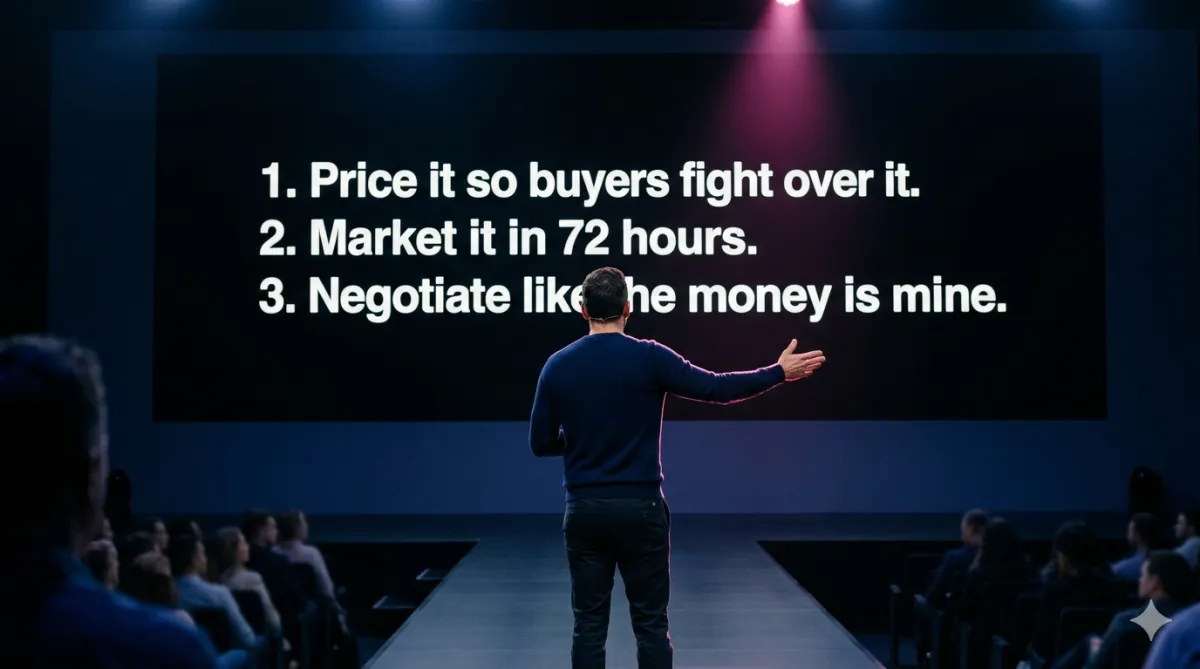
1. Price it so buyers fight over it
2. Market it so every serious buyer sees it in 72 hours
3. Negotiate it like the money is mine
These three lines are the spine of the entire presentation.
Slide 4 - Pillar 1 Title
Headline: "Price it so buyers fight over it."
Subhead: "The right price in week one beats the wrong price for six months."
Slide 5 - Why Pricing Wins or Loses Listings
Plain English: a listing's first 14 days are an emergency room. After that, your home starts dying on the market. Buyers assume something is wrong with it. Showings drop. Price reductions stack. The home sells for less than it would have if priced correctly on day one.
Slide 6 - Your Home's Number
CMA preview. Don't dump comps. Show the strategic price range and explain why. Frame the recommendation as the price that creates competition, not the price that "tests the market."
Slide 7 - Pillar 2 Title
Headline: "Market it so every serious buyer sees it in 72 hours."
Subhead: "If they don't see it in week one, they're already touring something else."
Slide 8 - How Buyers Actually Find Homes
Walk through the buyer journey in plain English: late night Zillow scrolling, agent emails, social, word of mouth. Frame the marketing plan as meeting buyers where they actually are.
Slide 9 - The Launch Plan
Marketing components, but each rewritten as an outcome:
- "Buyers scrolling Zillow at 11pm stop on your home instead of swiping past it." (photo and video)
- "In front of every serious buyer in the metro by Saturday morning." (syndication and email)
- "47 specific buyers who toured homes like yours in the last 90 days get a personal call Monday." (database outreach)
- "Your home shows up in the feed of every neighbor and friend in a 10 mile radius." (social and paid)
Use icons or photos, not bullet stacks.
Slide 10 - Pillar 3 Title
Headline: "Negotiate it like the money is mine."
Subhead: "The biggest checks in this transaction are written in the last two weeks, not the first."
Slide 11 - The Moments That Matter
Where deals are won or lost in plain English: the offer, the inspection, the appraisal, the financing contingency. How I handle each one. Frame this as protecting the seller's check, not "negotiation expertise."
Slide 12 - Track Record
ONE slide. Two or three short stats with context. Example: "Average days on market in this zip code: 23. Mine: 11." Or: "Of the last 14 listings, 12 sold above asking." Skip vanity numbers. Use only stats that map to one of the three pillars.
Slide 13 - What Other Sellers Said
Two or three short testimonials. One sentence each. Pulled from past clients in similar situations.
Slide 14 - About Me (Briefly)
Now, and only now, a short bio slide. Two or three lines. What I do, who I do it for, why I do it. No awards lists.
Slide 15 - What Happens Next
Clear timeline:
- This week: sign the agreement, prep photography
- Next week: launch
- Day 14 checkpoint: review market response together
- Close: target date based on local averages
Slide 16 - The Ask
Headline: "Let's get your home sold."
Subline: "Sign here and we launch this week."
Direct close. No "thank you for your time."
CRITICAL RULES:
- Every feature must be rewritten as an outcome the seller can picture.
- No corporate jargon. No "leveraging," no "comprehensive," no "proven track record."
- The seller should be able to recite the three pillars from memory at the end of the meeting.
- The "About Me" slide is slide 14, not slide 1.
- 16 slides max. Cut, don't add.


